If you’re trying to figure out the average cost of hardwood floor refinishing, you’ve probably seen numbers all over the place. Some websites say $2 per square foot. Others say $8 or more. That gap makes it hard to know what’s realistic.
In most U.S. markets in 2026, professional hardwood floor refinishing typically falls between $3.50 and $6.50 per square foot for a full sand and finish. Premium systems, complex layouts, or heavy repairs can push that higher.
The reason pricing varies is simple. No two floors are the same. Condition, stain changes, repairs, layout, and finish type all affect labor and material cost.
As a national hardwood refinishing contractor, Fabulous Floors USA prices jobs across multiple markets every week. In this guide, we’ll break down real numbers, explain what drives cost, and help you understand what your project is likely to fall within.
What Is the Average Cost of Hardwood Floor Refinishing in 2026?
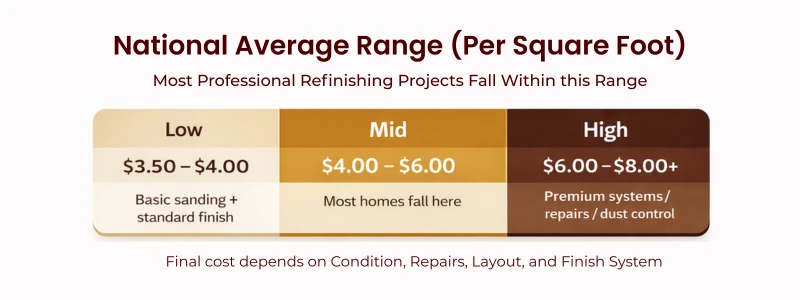
Now that you understand why prices vary, let’s look at the actual numbers.
In 2026, the average cost of hardwood floor refinishing in the United States typically ranges between $3.50 and $6.50 per square foot for a full sand and refinish completed by a professional contractor.
For homeowners who choose premium finishes, request dust-controlled systems, or need repairs, pricing can move into the $5 to $8+ per square foot range.
What That Means for a Typical Home
Most refinishing projects fall between 800 and 1,000 square feet, which usually covers a main living area or first floor.
Here’s what that looks like in real terms:
- 800 sq ft × $4.50 per sq ft (mid-range average) = ~$3,600
- 1,000 sq ft × $4.00 per sq ft = ~$4,000
- 1,000 sq ft with repairs and stain change = $4,800–$6,000
Those numbers reflect full sanding, proper grit progression, and three coats of professional-grade finish.
Why Online Estimates Vary So Much
You may see websites quoting $2 per square foot. In most established U.S. markets, that price does not include:
- Repair work
- Stain changes
- Premium finishes
- Dust control systems
- Proper multi-pass sanding
On the other end, luxury markets and high-end custom homes can exceed $8 per square foot due to labor rates, layout complexity, and finish selection.
The key takeaway is this: the national average falls in a predictable band, but your exact number depends on your floor’s condition and your expectations for durability and appearance.
If you already know your approximate square footage, you can get a clearer estimate by using the cost-per-square-foot breakdown below.
Hardwood Floor Refinishing Cost Per Square Foot (Tier Breakdown)
National averages are helpful, but homeowners usually want to know where their project falls.
Most refinishing jobs land in one of three pricing tiers. The difference comes down to labor depth, finish type, dust control, and repair needs.
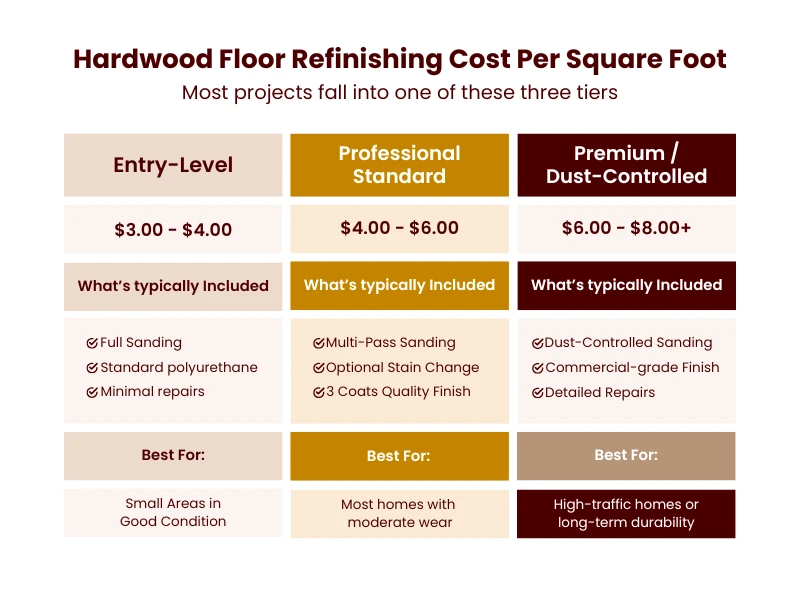
These ranges reflect professional work in established U.S. markets. Labor rates vary by city, but the structure remains consistent.
What This Looks Like by Home Size
To make it more practical, here are realistic project totals.
500 sq ft (small living room + hallway)
- $1,750 – $3,000 depending on tier
1,000 sq ft (average main floor)
- $3,500 – $6,000 depending on condition and finish
1,500 sq ft (large main level)
- $5,500 – $10,000+ for premium systems and repairs
If stairs are involved, add additional labor. Stair refinishing is more time-intensive than flat flooring and is usually priced separately.
Why Tier Placement Matters
The difference between $4 and $7 per square foot is not random. It usually reflects:
- Finish durability
- Dust containment
- Number of sanding passes
- Repair complexity
- Warranty coverage
If your floors are in good shape and you’re staying natural, you may sit near the middle of the range. If you want dark stain, dust containment, and a high-performance finish, expect the upper range.
Numbers are helpful, but real homes tell the story better. Here’s what these ranges look like in actual projects.
Real Project Cost Examples (From Actual Jobs)
National averages are helpful, but homeowners often ask a more practical question:
“What does it actually cost to refinish hardwood floors like mine?”
Below are real-world examples that show how square footage, condition, and finish choice affect pricing.
Case Study 1 — 1,000 Sq Ft Red Oak, Moderate Wear
Square Footage: 1,000 sq ft
Wood Type: Red oak
Condition: Worn finish, surface scratches, no structural damage
Scope: Full sand and refinish, natural color, three coats of water-based polyurethane
Time on Site: 3 days
Final Cost: ~$4,000
For this homeowner, the cost to refinish 1,000 sq ft hardwood floors landed near the middle of the national range. There were no major repairs and no stain change, which kept labor predictable.
This is a typical example of the average cost of hardwood floor refinishing in a standard U.S. home.
Case Study 2 — 800 Sq Ft With Pet Stains and Color Change
Square Footage: 800 sq ft
Wood Type: Oak
Condition: Deep pet stains in traffic areas
Scope: Full sand, selective board replacement, dark stain application, three coats satin finish
Time on Site: 4 days
Final Cost: ~$4,800
Pet stains required additional sanding passes and several board replacements. Dark stain also demands more precision because it highlights sanding marks.
This example shows how the cost to sand and refinish hardwood floors increases when condition issues are discovered after sanding begins.
Case Study 3 — 1,500 Sq Ft Premium Dust-Controlled System + Stairs
Square Footage: 1,350 sq ft main level + 150 sq ft stairs
Wood Type: Oak
Condition: Heavy wear, ambered oil finish
Scope: Dust-controlled sanding system, sealer + 2 coats commercial-grade waterborne finish, stair refinishing
Time on Site: 5 days
Final Cost: ~$10,500
In this case, the dustless hardwood floor refinishing cost was higher due to:
- HEPA dust containment equipment
- Commercial-grade finish
- High-labor stair work
Premium systems add material cost and time, but many homeowners prefer the reduced dust and faster cure time.
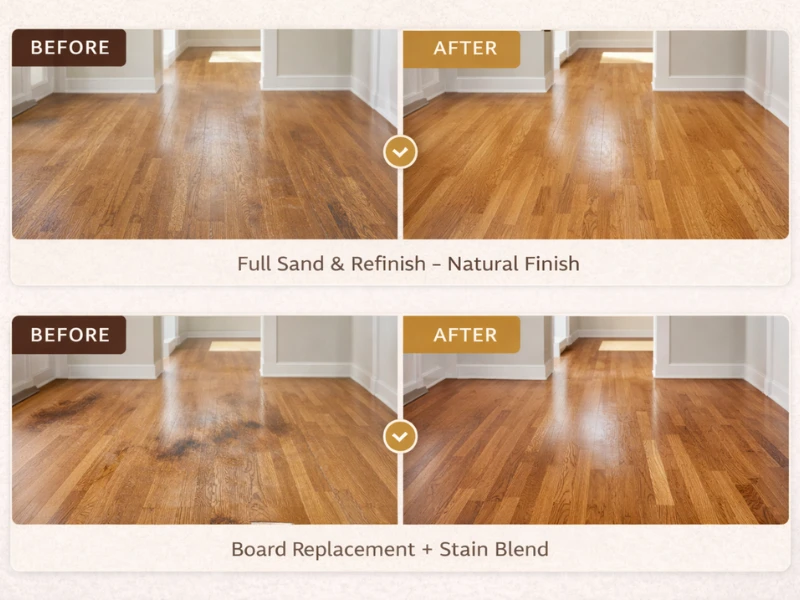
You can also see completed refinishing projects in our gallery to compare different wood types and stain results.
What These Examples Show
When people search “how much does hardwood refinishing cost,” they are usually trying to picture their own floors.
From these projects, you can see:
- Condition drives price more than square footage alone
- Stain changes add labor
- Repairs increase cost quickly
- Dust-controlled systems sit at the top of the pricing range
If you’re comparing hardwood resurfacing vs refinishing cost, the next section will clarify when a full sand is necessary and when it may not be.
What Affects the Cost of Refinishing Hardwood Floors? (Ranked by Impact)
By now, you’ve seen the average cost ranges. The next question is what actually moves a project from $4 per square foot to $7 or more.
In real-world refinishing jobs, pricing is not random. Certain factors consistently drive the cost up or keep it stable. Below is how we see it ranked in the field.
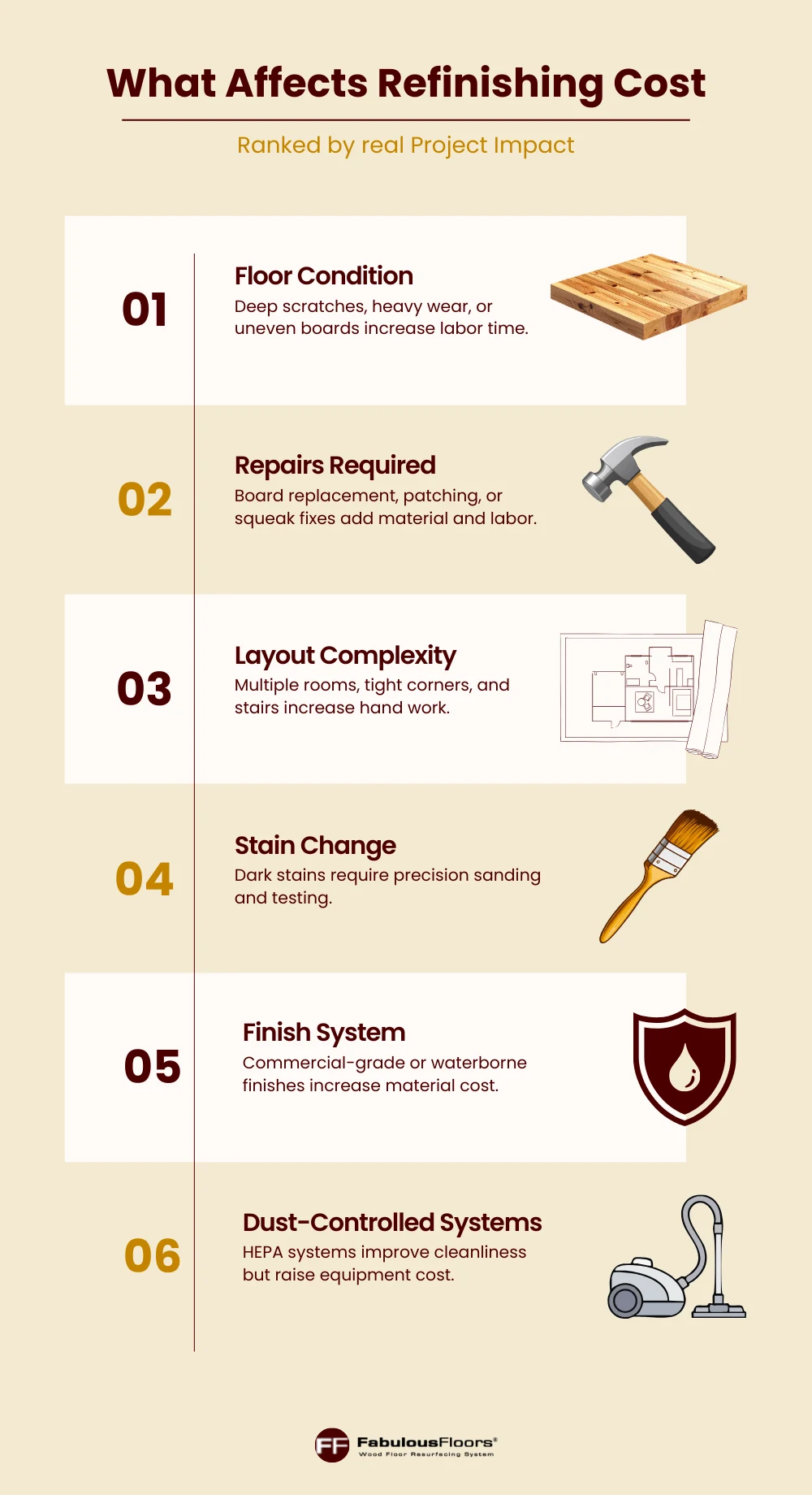
Floor Condition
Condition is the single biggest pricing driver.
Floors with light surface wear are faster to sand and finish. Floors with deep scratches, heavy traffic wear, cupping, or uneven boards require more sanding passes and more attention to detail.
If pet stains have penetrated deeply or previous sanding was uneven, correcting those issues takes additional labor. That directly impacts the hardwood floor refinishing cost per square foot.
Repairs Required
Repairs can shift a project quickly.
Board replacement, patching damaged areas, fixing loose boards, or addressing squeaks adds time and material cost. Even replacing a few oak boards can add several hundred dollars to a project.
When homeowners ask about the cost to refinish oak hardwood floors, they often do not factor in repair work. Refinishing and repair are separate scopes, even though they happen during the same project.
Layout Complexity
Open floor plans are more efficient to sand than homes with multiple small rooms, closets, tight hallways, and stair transitions.
More edges mean more hand work. More hand work means more labor hours. That labor is reflected in the average cost of hardwood floor refinishing for that home.
Stairs are especially labor-intensive and are typically priced separately.
Stain Change
Keeping floors natural is usually the most straightforward option.
Changing from light to dark stain or reversing an old dark stain requires additional sanding precision and sample testing. Dark stains also show imperfections more easily, so sanding must be more refined.
This is one reason the cost to sand and refinish hardwood floors increases when color changes are involved.
Previous Finish Contamination
Old wax, acrylic polish, oil soaps, or unknown coatings can interfere with adhesion.
If contamination is discovered during sanding, extra steps are required to ensure the new finish bonds properly. Skipping that step risks peeling or finish failure later.
This is rarely visible before sanding begins, which is why site evaluation matters.
Finish Type
Standard oil-based polyurethane sits at the lower end of the cost range.
Water-based finishes dry faster and remain clearer over time, but they cost more per gallon. Commercial-grade systems, such as high-traffic waterborne finishes, raise material cost further.
If you are comparing dustless hardwood floor refinishing cost to traditional sanding, the finish system often plays a role in the pricing difference.
Dustless Sanding Systems
True dust-controlled systems use HEPA vacuum equipment connected directly to sanding machines.
These systems reduce airborne dust significantly, but they require specialized equipment and maintenance. That is why dustless hardwood floor refinishing cost typically falls at the higher end of the per-square-foot range.
Many homeowners choose this option for comfort and cleaner job sites.
Furniture Moving
Furniture removal is sometimes included in larger projects and sometimes priced separately.
While it does not change sanding time dramatically, it affects setup and labor logistics. In smaller jobs, it may be a noticeable line item.
Hidden Costs Homeowners Underestimate
Even when reviewing averages online, a few cost drivers surprise homeowners once a project begins.
Pet Urine Damage
Surface discoloration can often be sanded out.
Deep pet urine stains may have penetrated into the board fibers. In those cases, sanding alone will not remove the damage. Board replacement becomes necessary, which increases total cost.
This is one of the most common reasons the cost to refinish 1000 sq ft hardwood floors rises beyond the initial estimate.
Wax or Polish Contamination
Many maintenance products leave a residue that interferes with new finish adhesion.
If wax or acrylic buildup is discovered during sanding, extra preparation steps are required. Ignoring it risks finish failure.
This is not always visible before sanding begins.
Subfloor Problems
If boards are loose, uneven, or affected by moisture, addressing the surface alone does not solve the issue.
Subfloor corrections increase labor time and may require carpentry work before refinishing can continue.
Thin Engineered Wear Layers
Not all hardwood floors can be safely sanded.
Some engineered hardwood products have thin wear layers that cannot handle aggressive sanding. In those cases, homeowners may need to consider hardwood resurfacing vs refinishing cost differences or replacement.
A professional evaluation determines what is structurally safe.
The takeaway is simple: square footage gives you a starting point. Condition and scope determine where your final price lands within that range.
Before committing, most homeowners also want to understand the timeline and how long rooms will be unusable.
How Long Does Hardwood Floor Refinishing Take?
After asking about cost, the next question homeowners usually ask is how long the house will be disrupted.
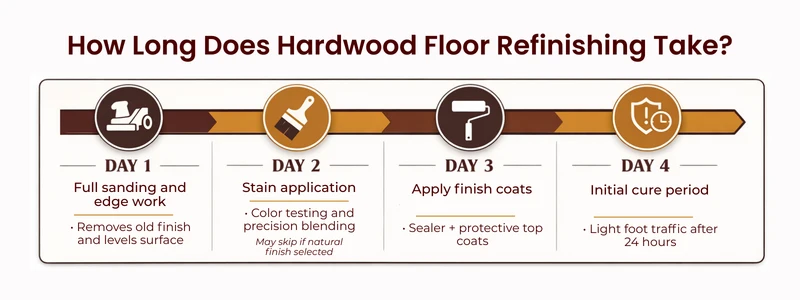
The timeline depends on square footage, condition, and finish type, but most professional refinishing projects follow a predictable schedule.
500 Square Feet
A smaller project, such as a living room and hallway totaling around 500 square feet, typically takes:
- 2 to 3 days on site
- Day 1: Sanding and prep
- Day 2: Stain (if selected) and first finish coat
- Day 3: Final coat and light inspection
If no stain change is involved and the floors are in good condition, some jobs may finish closer to two days.
1,000 Square Feet
For a main level around 1,000 square feet:
- 3 to 4 days on site
- Day 1: Full sanding and edging
- Day 2: Fine sanding and stain application
- Day 3: Finish coats
- Day 4 (if needed): Additional coat or detail work
Larger homes or projects involving repairs, dark stains, or complex layouts may extend slightly beyond this range.
When homeowners research the cost to refinish 1000 sq ft hardwood floors, timeline is usually part of the decision. The labor days directly influence pricing and finish performance.
Cure Time After Final Coat
Refinishing is not complete the moment the last coat is applied.
Different finishes have different cure schedules:
- Water-based finishes
- Light foot traffic in socks: 24 hours
- Furniture return: 3 to 5 days
- Full cure: 7 to 14 days
- Oil-based finishes
- Light foot traffic: 48 to 72 hours
- Furniture return: 5 to 7 days
- Full cure: up to 30 days
Premium commercial-grade finishes may cure faster but still require careful handling during the first week.
When Can Furniture Go Back?
Furniture can usually return within 3 to 7 days depending on the finish type.
Heavy items should be lifted, not dragged. Protective pads should be installed before placement. This protects the new surface during early cure stages.
When Can Rugs Be Placed?
Area rugs should not be placed back immediately.
Most contractors recommend waiting:
- 7 to 14 days for water-based systems
- 2 to 4 weeks for oil-based systems
Placing rugs too early can trap solvents and affect cure quality.
Why Timeline Matters for Cost
Timeline affects scheduling, labor allocation, and whether dustless systems or faster-curing finishes are selected.
For homeowners balancing work, pets, and family life, the difference between a 3-day project and a 5-day project can influence whether they choose standard refinishing or explore hardwood resurfacing vs refinishing cost alternatives.
Up next, we’ll break down that comparison clearly so you can see when a full sand is necessary and when it may not be.
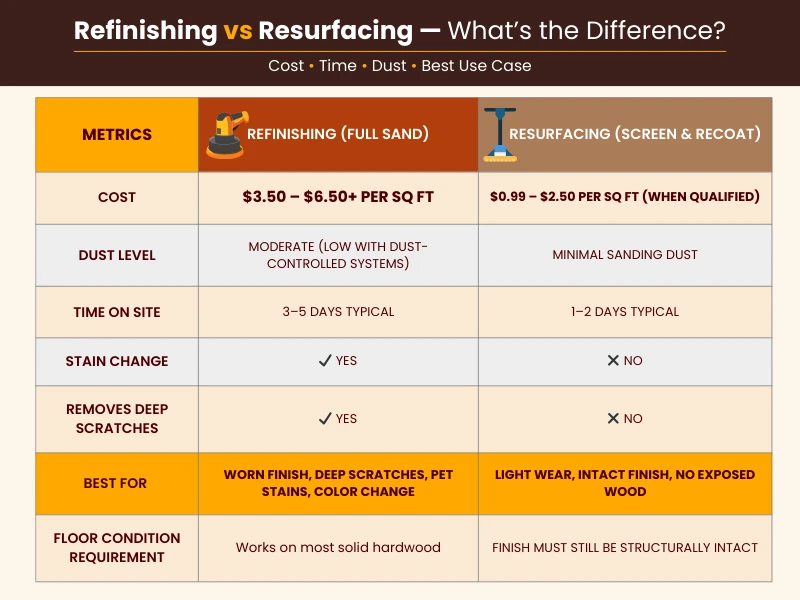
Refinishing vs Resurfacing Cost Comparison
Many homeowners searching for the average cost of hardwood floor refinishing are also comparing it to resurfacing.
The two services are not the same. They serve different floor conditions and come with different price points, timelines, and levels of disruption.
If your floors qualify for resurfacing, the total investment may be significantly lower. If they do not, a full sand and refinish is the correct solution.
Here’s how they compare.
When Full Refinishing Is Necessary
Refinishing is required when:
- The finish is worn through to bare wood
- There are deep scratches
- Pet stains have penetrated
- You want to change stain color
- The floor has been previously refinished unevenly
This is where the cost to sand and refinish hardwood floors becomes necessary because the wood surface itself must be leveled.
When Resurfacing May Be Enough
Resurfacing works when:
- The finish is dull but not worn through
- There are light surface scratches only
- You are keeping the same stain color
- The floor has not been contaminated with wax or polish
Because resurfacing does not remove layers of wood, it costs less and finishes faster.
Why the Cost Difference Is Significant
Resurfacing avoids the heavy sanding stage. That means:
- Fewer labor hours
- Less material usage
- Shorter project timeline
That is why hardwood resurfacing vs refinishing cost can differ by several dollars per square foot.
However, resurfacing is not a shortcut for damaged floors. If the wood itself is compromised, skipping a full sand may result in uneven appearance or adhesion problems.
Is It Cheaper to Refinish or Replace Hardwood Floors?
In most situations, refinishing is significantly less expensive than full replacement.
While the average cost of hardwood floor refinishing typically falls between $3.50 and $6.50 per square foot, full hardwood floor replacement often ranges from $8 to $15+ per square foot installed.
That replacement range includes:
- Demolition and disposal of old flooring
- New hardwood material
- Installation labor
- Sanding and finishing (for site-finished floors)
In higher-cost markets or for premium wood species, replacement can exceed $18 per square foot.
What That Looks Like in a Real Home
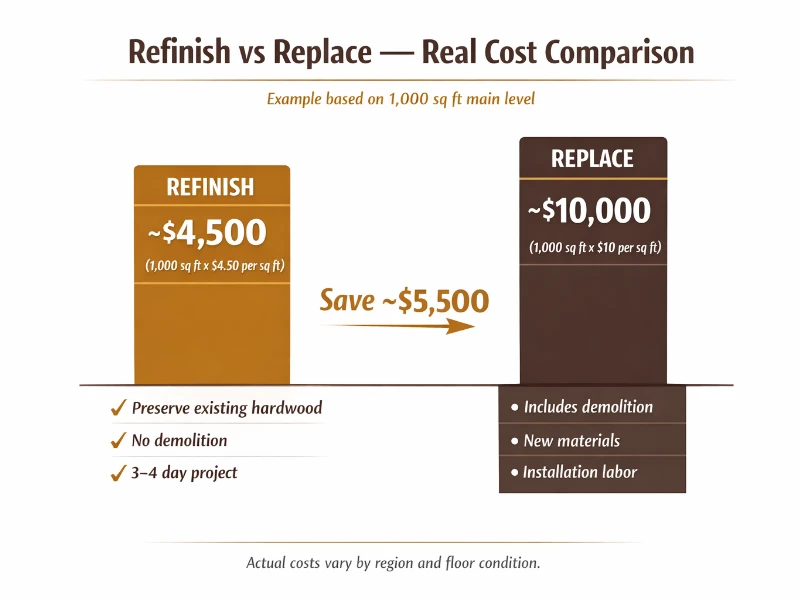
Let’s compare a 1,000 square foot main level.
Refinishing (mid-range example)
1,000 sq ft × $4.50 per sq ft = ~$4,500
Replacement (mid-range hardwood install)
1,000 sq ft × $10 per sq ft = ~$10,000
That’s a difference of roughly $5,000 or more.
On larger homes, the gap widens quickly.
A 1,800 sq ft main level could cost:
- $8,000–$10,000 to refinish
- $18,000–$25,000+ to replace
For many homeowners, refinishing preserves solid hardwood and saves 50% to 70% compared to new installation.
When Replacement Makes Sense
Refinishing is not always the right answer.
Replacement may be necessary when:
- The wood has been sanded too many times
- Severe water damage affects large sections
- Subfloor structural issues exist
- Engineered flooring has a thin wear layer that cannot be sanded
In those cases, investing in new flooring may be more practical long term.
Long-Term Return on Investment
Solid hardwood floors can often be refinished multiple times over their lifespan. Maintaining and restoring existing wood typically preserves home value while avoiding demolition costs.
Buyers consistently view refinished hardwood as a positive feature. Clean, restored flooring can increase perceived home value without the higher capital outlay of replacement.
For homeowners evaluating cost to refinish oak hardwood floors versus installing new hardwood, the financial difference alone makes refinishing the first option to consider in most cases.
DIY vs Professional Hardwood Floor Refinishing Cost
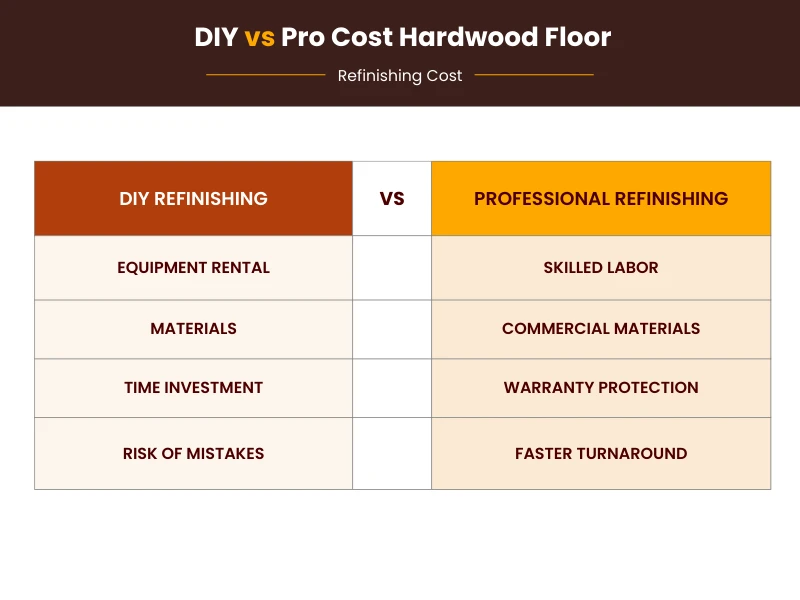
Some homeowners researching the average cost of hardwood floor refinishing consider doing the project themselves. On the surface, renting equipment appears cheaper.
The real cost depends on experience, time, and risk tolerance.
Equipment Rental Cost
Most DIY refinishing projects require:
- Drum or belt sander rental: $60–$100 per day
- Edger rental: $40–$60 per day
- Buffer rental: $40–$60 per day
- Shop vacuum and accessories
For a typical 3-day project, equipment rental alone often lands between $200 and $400, sometimes more if the job runs longer.
Material Cost
Materials are not minor expenses.
- Sandpaper (multiple grits): $100–$200
- Wood filler: $30–$100
- Stain (if changing color): $50–$150
- Polyurethane finish: $200–$600 depending on quality
- Applicators, rollers, brushes, tape, plastic
Total material costs can reach $400–$900 depending on square footage and finish choice.
When calculating DIY hardwood floor refinishing cost, many homeowners underestimate consumables like sandpaper. Heavily worn floors burn through abrasive quickly.
Time Cost
Time is often the biggest overlooked factor.
A 1,000 sq ft refinishing project may take a professional crew 3 to 4 days. A first-time DIY project can take longer, especially when:
- Learning how to control the drum sander
- Fixing uneven sanding passes
- Waiting for additional drying time
For homeowners taking time off work or working evenings and weekends, the project can stretch over one to two weeks.
Common DIY Mistakes
From a contractor perspective, most costly DIY errors fall into a few categories:
- Drum marks from pausing while sanding
- Edge dish-out where perimeter sanding goes too deep
- Swirl marks visible after stain application
- Uneven stain absorption
- Finish adhesion problems due to contamination
Correcting these issues later often requires a full re-sand, which eliminates the initial savings.
We regularly refinish floors that were previously attempted by homeowners. The repair work typically costs more than if the job had been professionally completed from the start.
When DIY Makes Sense
DIY refinishing may be reasonable when:
- The area is small (under 300–400 sq ft)
- The floor is relatively flat and in good condition
- You are keeping the same natural color
- You are comfortable learning equipment handling
For small secondary spaces, the savings may justify the effort.
When It Becomes Expensive
DIY becomes costly when:
- The floor requires stain changes
- Deep scratches or pet stains are present
- The home is occupied during the project
- You want commercial-grade durability
- The finish fails and must be redone
At that point, professional refinishing is not just about labor. It is about avoiding redo work and protecting the wood.
When comparing DIY hardwood floor refinishing cost to professional pricing, the gap narrows quickly once time, risk, and materials are calculated accurately.
When Hardwood Floor Refinishing Is Too Cheap (Red Flags)
It is normal to compare bids. But if you see pricing far below the typical range, it’s worth asking more questions.
Across most U.S. markets, a full sand and refinish priced at $2 per square foot or less is difficult to sustain while covering proper labor, materials, and insurance.
Lower pricing does not automatically mean poor work. It does mean you should understand exactly what is included.
Here are a few things to confirm before choosing the lowest bid.
Grit Progression
Proper refinishing requires multiple sanding passes using progressively finer grits.
A typical professional progression may include:
- Coarse cut
- Intermediate cut
- Fine sanding
- Final blending pass
If only one or two passes are used, the floor may look acceptable at first but show sanding marks later, especially under dark stain.
Number of Finish Coats
A professional refinish typically includes three coats total (sealer plus two finish coats, or three finish coats depending on system).
If a bid includes only one or two coats, durability may be reduced. Finish thickness affects how long the floor will last before another maintenance cycle.
Dust Containment
Standard sanding produces dust. Modern dust-controlled systems significantly reduce airborne particles.
If dust management is not addressed at all, ask how the contractor plans to protect adjacent rooms.
This directly affects homeowner comfort during the project.
Written Scope and Warranty
Clear estimates should outline:
- Square footage
- Number of coats
- Finish type
- Repair scope
- Timeline
A written warranty or workmanship guarantee adds accountability.
If details are vague or verbal only, request clarification before moving forward.
The average cost of hardwood floor refinishing reflects labor depth and material quality. Verifying what is included protects both your investment and the longevity of your floors.
FAQs About Hardwood Floor Refinishing Cost
How much does it cost to refinish 1,000 sq ft of hardwood floors?
Refinishing 1,000 square feet typically costs between $3,500 and $6,500, depending on condition, stain choice, and finish type. Floors in good condition without repairs often fall near the middle of that range. Projects involving pet stains, board replacement, or premium finishes may move toward the higher end.
How much does it cost to refinish 500 sq ft?
For 500 square feet, most homeowners spend between $1,750 and $3,000. Smaller projects sometimes carry a minimum service cost, so the per-square-foot price may be slightly higher than larger jobs. Condition and finish selection still play a significant role in final pricing.
Is dustless sanding worth it?
Dust-controlled sanding systems reduce airborne particles and help keep surrounding areas cleaner. They typically add to the per-square-foot cost, but many homeowners prefer the reduced cleanup and improved air quality during the project. It does not eliminate all dust, but it significantly reduces it.
Does refinishing increase home value?
Refinished hardwood floors generally improve visual appeal and buyer perception. Clean, restored flooring can make a home feel updated without the cost of replacement. While exact return varies by market, refinishing is often viewed as a cost-effective improvement compared to installing new hardwood.
How long does hardwood floor refinishing last?
A professionally refinished floor typically lasts 7 to 15 years before another full sanding is needed. Longevity depends on traffic levels, maintenance habits, and finish type. High-performance waterborne finishes may extend durability in busy households.
Can engineered hardwood be refinished?
Some engineered hardwood can be refinished, but it depends on the thickness of the wear layer. Floors with a thick wear layer may tolerate sanding once or twice. Thin veneer products often cannot be safely sanded and may require resurfacing or replacement instead.
How many times can hardwood floors be refinished?
Solid hardwood floors can usually be refinished multiple times over their lifespan. The exact number depends on board thickness and previous sanding depth. Many solid hardwood floors can handle three to five refinishing cycles if properly maintained.
Get Your Exact Hardwood Floor Refinishing Cost
By now, you have a realistic understanding of the average cost of hardwood floor refinishing and what drives pricing up or down.
Square footage gives you a starting point. Condition, finish choice, and repair needs determine where your project falls within the range.
If you want an exact number instead of a national average, the next step is simple.
Request a Free In-Home Estimate
A professional evaluation confirms:
- Exact square footage
- Floor condition
- Whether repairs are needed
- Whether resurfacing is possible
- Finish options and durability expectations
There is no guesswork once the floor is inspected.
See If You Qualify for 99¢ Resurfacing
If your finish is still intact and your floors only show light wear, you may not need a full sand.
Resurfacing can cost significantly less than full refinishing when the floor qualifies. A quick inspection determines eligibility.
Get a Personalized Quote Based on Your Square Footage
If you already know your approximate square footage, you can request a customized estimate based on your home’s layout and condition.
Understanding your options clearly allows you to choose the right solution without overpaying or underestimating the scope.